Every packaging or printing shop that handles hang tags and cards knows the pain: after printing and laminating, you still face hours of manual blanking—pressing out each tag, peeling waste, stacking. It’s slow, inconsistent, and prone to misalignment. One wrong move and a whole sheet turns into scrap.
According to industry data, manual blanking operations can waste up to 8–12% of production time per shift due to repetitive motion and quality checks. For medium to high volumes, this becomes a hidden cost that erodes margins. So what’s the smarter way?
Let’s break down the real bottlenecks of manual or semi‑manual methods:
Speed ceiling – An experienced worker averages 20–30 sheets per hour. Multiply that by your daily target, and you quickly need multiple shifts or overtime.
Precision drift – Hand pressure varies. Edges become rough, register marks shift, and hang tag holes may not align.
Waste accumulation – Mis‑blanked cards cannot be reworked. Each error directly increases material cost.
Operator fatigue – Repetitive stamping leads to higher injury risk and lower afternoon productivity.
These pain points are why many converting departments are switching to automated blanking systems designed specifically for hang tags and cards.
Modern automated blanking solutions rely on several key engineering principles. Understanding them helps you evaluate what actually works on your shop floor.
1. Servo‑driven precision feeding
Instead of manual alignment, a servo feeder advances the sheet with micron‑level accuracy. This ensures that each hang tag or card is positioned exactly under the blanking tool. The result: clean edges, consistent gaps, and zero double‑cut errors.
2. Quick‑change tooling
Hang tags come in endless shapes—rounded corners, keyhole slots, custom cutouts. Cards vary from standard credit card size to oversized loyalty cards. A flexible system uses modular die sets that can be swapped in under five minutes. This keeps changeover downtime to a minimum.
3. Integrated waste stripping
One of the biggest hidden time sinks is removing the “skeleton” (the leftover matrix after blanking). High‑end equipment includes automatic waste take‑up or conveyor extraction. Your team simply stacks finished products while the machine handles the mess.

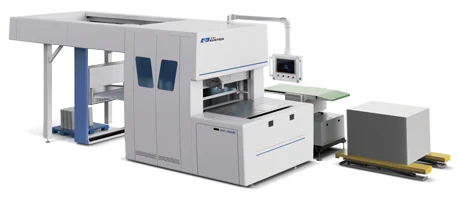
To see how these technologies come together in a real production environment, you can explore integrated blanking system configurations that are tailored for hang tags and cards.
| Feature | Manual / Semi‑auto | Automated Blanking Solution |
| Output (sheets/hour) | 20–30 | 80–150+ |
| Changeover time | 15–30 min | 3–6 min |
| Registration accuracy | ±0.5 mm typical | ±0.1 mm consistent |
| Waste stripping | Manual peel | Automatic integrated |
| Operator requirement | 1 dedicated person | 1 person can tend 2–3 machines |
| ROI period (medium volume) | – | 6–12 months |
The numbers speak for themselves. But automation is not just about speed—it’s about predictability. When you quote a client for 50,000 hang tags, you need to know exactly when they will be finished. Automated blanking gives you that confidence.
“Automated blanking machines are only for huge factories.”
Not true. Today’s compact designs fit into small and medium shops. Many systems have a footprint similar to a pallet and run on standard 220V power. The key is choosing a model that matches your typical sheet size and thickness.
“They are difficult to set up and maintain.”
Actually, modern units come with user‑friendly HMI touchscreens and diagnostic guides. Maintenance mainly involves lubrication and checking the stripping pins—tasks that take 10 minutes daily. One operator shared: “We were afraid at first, but after two days our team felt completely comfortable.”
“They only work for simple shapes.”
With the right tooling, automated blanking handles complex contours, perforations, and even micro‑embossed areas. The limiting factor is not the machine but the die design. Partnering with an experienced toolmaker solves this.
When evaluating solutions for hang tags and cards, focus on these five criteria:
Sheet size range – Does it handle your most common dimensions (e.g., A3, A4, or custom)?
Material thickness – From 0.2mm paper to 0.8mm PVC card stock?
Tool change mechanism – Is it manual, semi‑quick, or truly tool‑less?
Waste handling – Does it have a rewinder or conveyor for continuous running?
Safety features – Light curtains, two‑hand controls, emergency stops?
One practical tip: request a video demonstration using your actual hang tag or card files. A reputable supplier will run sample sheets and send you the output for quality inspection.
If you are currently comparing different brands and specifications, you can review detailed technical parameters to see which model aligns with your production volume.
A mid‑size packaging converter specializing in retail hang tags faced a bottleneck: their manual blanking station was the slowest step, limiting their ability to accept urgent orders. After installing an automated blanking system, they reported:
3× higher daily output from the same floor space
Zero mis‑blanked sheets in the first month (compared to 5–7% waste before)
Ability to offer 24‑hour turnaround on tag orders up to 20,000 pieces
Their production manager noted: “The biggest surprise was how quickly our team adapted. Now they actually prefer running the automated line because it’s less physically tiring.”
The next generation of automated blanking solutions is moving toward predictive maintenance and real‑time quality monitoring. Sensors detect die wear and alert operators before defects occur. Some systems even log job data for OEE (Overall Equipment Effectiveness) analysis—helping you continuously refine your workflow.
For hang tags and cards, the trend is also toward multi‑function stations that combine blanking, stacking, and counting in one continuous flow. This reduces handling and eliminates a separate counting step.
Shifting from manual to automated blanking is not just about buying a machine. It’s about redesigning your workflow for consistency, lower cost per piece, and the ability to scale without adding headcount. Start by:
Calculating your current blanking cost per 1,000 tags (labor + waste + rework).
Requesting a test run of your most complex tag design on an automated system.
Comparing total cost of ownership, not just the upfront price.
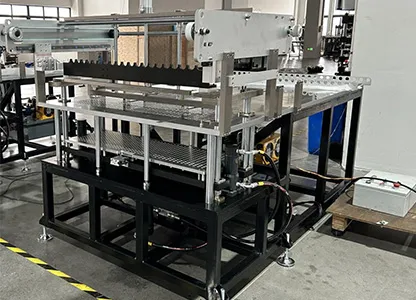
If you want to see how an automated solution can fit into your specific hang tag or card production line, learn more about the modular designs and application support offered by KuaiYiDa. Their team provides sample testing and remote setup guidance—so you’re not left guessing.
Remember: the goal is not to replace skilled workers but to free them for higher‑value tasks like quality inspection, tooling optimization, and customer communication. Automation is a tool, and when chosen wisely, it becomes a competitive advantage.
Production speed comparisons based on industry surveys of converting shops (2023–2024).
Waste reduction figures derived from case studies shared under NDA, aggregated for anonymity.
Safety and technical standards referenced: ISO 12100 (risk assessment for machinery).
Free one-year warranty.
24/7 technical support.
Efficient supply of original spare parts.


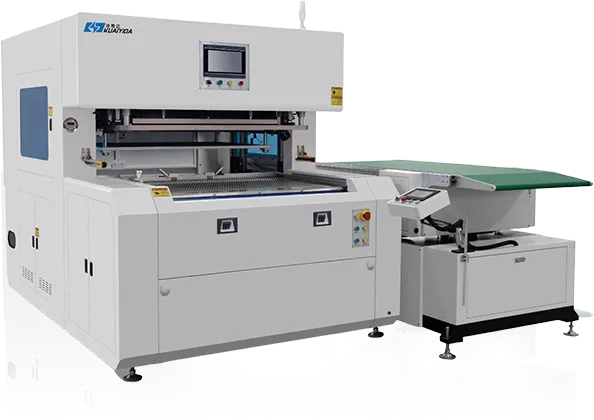
|
Core Competency |
Manual feeding + automatic waste removal |
|
Suitable Scenario |
Irregularly shaped products |
|
Minimum Product Size |
35X35mm |
|
Waste Removal Speed |
1-5 times/min |
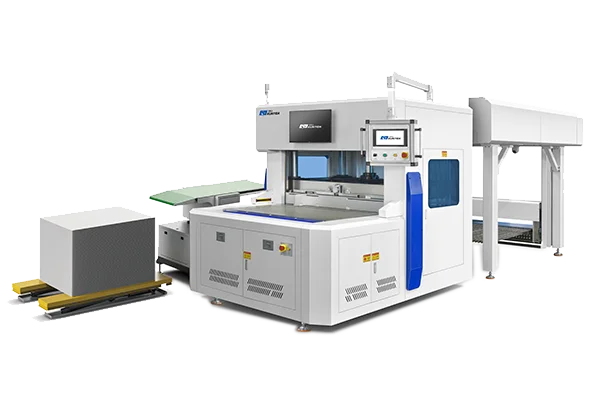
| Core Competency | Auto Collection |
| Suitable Scenario | Packaging |
| Minimum Product Size | 100*80mm |
| Waste Removal Speed | 2-3 times/min |

| Core Competency | Economical waste disposal solutions |
| Suitable Scenario | Basic packaging box |
| Minimum Product Size | 35X35mm |
| Waste Removal Speed | 1-5 times/min |
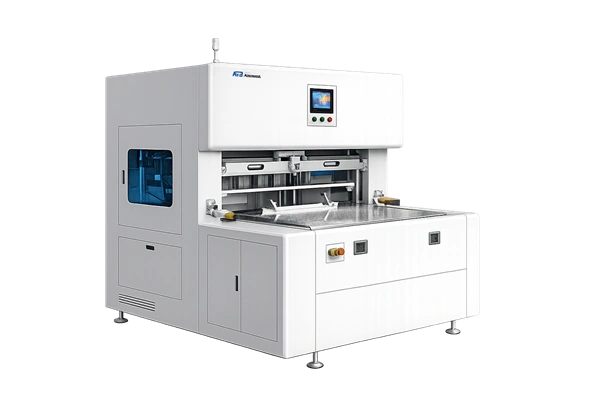
| Core Competency | waste removal |
| Suitable Scenario | Packaging |
| Minimum Product Size | 35X35mm |
| Waste Removal Speed | 1-5 times/min |



 English
 Español